Black Dahlia

The city of Los Angeles has thousands of real-life stories of actors and actresses who venture there seeking fame and fortune in the film world. For the large majority of them, they are dismissed after tense auditions and forced to either seek other opportunities in the film world or just give up the notion altogether. In 1947, Elizabeth Short was one such aspiring actress, whose big break never came. Along with Hollywood’s rejection, her dismembered and blood-drained corpse was found lying in the middle of a busy Los Angeles street. The most famous and unsolved murder of the time was to become known as the Black Dahlia Murder.

Elizabeth Short

Elizabeth Short - The Black Dahlia

Elizabeth Short born in 1924, was a native of Boston, Massachusetts. She was one of five daughters born to her parents Cleo and Phoebe Short. Living a middle-class lifestyle at a young age was about to come to a screeching halt as the Stock Market Crash of 1929 had the family reeling. Shortly thereafter, Cleo went missing. It was thought that he had committed suicide as his car was found abandoned on a nearby bridge.

However, in 1942, Phoebe received a letter from Cleo stating that he was in fact very much alive and had fled to make a better life in California. At the time Elizabeth became diagnosed with an asthma condition and at her doctor’s suggestion, a move to California would be beneficial to her health. A year later she joined her long lost father near the San Francisco Bay area. The relationship didn’t last long, and having such a great affinity for films, Elizabeth struck out for Los Angeles.

During the days, Elizabeth hit as many auditions as she could seeking any part that was available for stage or screen. In the evening, she moonlighted as a cocktail waitress trying to make any connection to an agent or producer that she came across. Distracting her from her goal as an actress was an aspiring married salesman named Robert Manley. Much about their relationship was unknown as they were known to travel to San Diego at off times for small getaways. January 9, 1947, after a return trip from San Diego, Manley dropped Short off at the Los Angeles Biltmore Hotel where she was to meet her sister who would be flying in from Boston for a visit. This was the last time Manley saw her alive.

The Black Dahlia Murder

The Black Dahlia Murder

On the morning of January 18, 1947, a woman and her daughter out for a morning stroll to nearby Leimert Park, came across a most unusual body on Norton Avenue in the grass area. At first, she perceived the body to be that of a department store mannequin because of its dismembered and stiffened limb appearance. Upon closer inspection, the woman realized it was no mannequin, but that of a human. The Los Angeles Police Department responded and investigated the scene.

The body was that of a white female who had been completely sawed in half at the waist. Medical examiners found that the body had been completely drained of blood, thus giving the corpse a bright white appearance. The body parts had been scrubbed completely clean with was what presumed to be a gasoline-like substance that eliminated any stains. One and a half feet away, the lower torso was found in relation to the upper one. The intestines from it were folded and neatly tucked underneath the buttocks of the corpse. Various two-inch slices and gashes to both the upper and lower torso were made by a knife of some type. The most disturbing was that the killer used this same knife to slice the upper cheeks of the mouth on the corpse, giving it a very elongated and grotesque smile.

An autopsy revealed the official cause of death to be hemorrhaging caused by head trauma. Short was positively identified via her fingerprints that matched up with an arrest in 1943 for petty crime. Journalist William Randolph Hearst’s The Examiner newspaper gave her the name of “Black Dahlia” as they had discovered she had last been seen wearing a tailored black suit dress that paired well against her jet black hair that was often seen with a freshly plucked dahlia flower in it.

The Black Dahlia Murderer Announces Himself, Kind Of.

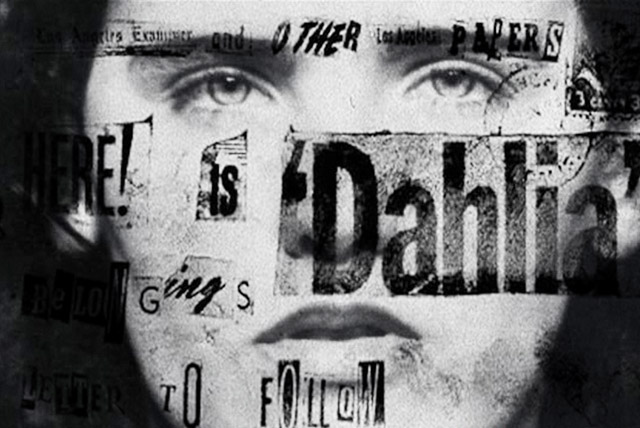
The media sensation was immediate and her death became among the first in Los Angeles to be heavily publicized in hopes of finding clues that may lead to the killer. Just days after death was in the news, James Richardson who was the editor of Hearst’s Examiner received a very bizarre phone call from a man. He claimed in no uncertain terms to be Elizabeth Short’s killer and stated he wanted to soon turn himself into the local authorities. But not before he mailed Elizabeth’s personal items to their newsroom.

The Black Dahlia Murder

On January 24, 1947, a United States Postal employee discovered a rather large envelope that was addressed to The Examiner. What made the discovery so bizarre is that there was no physical handwriting to it. Instead, a mishmash of newspaper and magazine letter cutups were used to address the envelope so that the handwriting and return address could not be validly traced. Los Angeles Police was called and the envelope was opened and its contents were shocking.

Inside was Elizabeth Short’s birth certificate, an assortment of photographs, business cards, an address book. Even stranger was the fact that the items were thoroughly cleaned with gasoline similar to how Elizabeth’s body was found. A latent print was discovered on the inside envelope lip and it was sent away to the FBI forensics lab for testing only to be determined that the results were inconclusive and matched to nobody.

At the exact same time that the envelope was delivered to the examiner, exactly two miles away on Norton Avenue where Short’s body was discovered, her handbag and matching pair of black suede shoes were placed atop sidewalk garbage. As police collected the evidence, the smell and presence of gasoline further confirmed that the killer had made the extra effort to see that these were void of traceable fingerprints as well. However, there was one key piece of evidence, the address book.

Who Killed Elizabeth Short?

Police quickly recognized the name of Mark Hansen in the address book. He was known in Los Angeles as a very wealthy theater and nightclub entrepreneur. Short had been a frequent patron of Hansen’s establishments and known to be seen alone with him. Things soured one evening when she spurned his sexual advances. Hansen was interviewed thoroughly by detectives, but ultimately had numerous alibis that had placed him somewhere else at the time of Short’s murder.

Combing through the address book, detectives confronted and interviewed a staggering one hundred and forty-seven potential suspects. Investigators from the Sheriff’s Department as well as California State Patrol offered their assistance, including the FBI as well. Local politician Lloyd Davis offered a staggering ten thousand dollar reward for information leading to Short’s killer. This was a controversial move as it further muddled the suspect pool as many people desperate for cash turned over a multitude of names.

Hope seemed to be waning until The Examiner received another contact from Short’s killer. No mashed-in newspaper cutups, this time the letter was handwritten and bizarrely stated,

“Here it is. Turning in Wed., Jan. 29, 10 am. Had my fun at police. Black Dahlia Avenger”.

Toying with authorities that the killer would turn themselves in, police eventually agreed the killer had no real intentions of doing so when The Examiner received another handwritten letter saying,

“Have changed my mind. You would not give me a square deal. Dahlia killing was justified”.

The Black Dahlia Murder

Dr. George Hodel

Theories on just who might be the killer had detectives scouring any and all Los Angeles contacts who associated with short. Sensational yellow journalism sparked a controversy that Short was a prostitute who spurned the wrong client, others labeled her as a nightclub tease who went too far at teasing men.

Leads and false confessions finally had police at a complete dead end. The final step at a lead came with examinations to Short’s body since her torso had been meticulously cut in half, the local medical schools were looked at as the killer could possibly have been in a doctor. Dr. George Hodel was rumored to be involved as a grand jury report from 1949 contained an actual wiretapping recording of his phone where he all but said that he was the killer.

Did the bellhop kill her?

Over the years the unsolved crime faded away as others popped up that took over the headlines. One of the most absolute and lasting suspect theories out there involves a bellhop for the Biltmore Hotel. Leslie Dillon worked for the hotel as well as being a former mortician and turned out to be friends with earlier suspect, Mark Hansen. Further research believed that Hansen, who incidentally trained as a medical student in Sweden years prior, helped murder Short along with Dillon.

The Black Dahlia Murder

Leslie Dillon

The prevailing theory is that Short discovered, through her friendship with Hansen, that he and Dillon were going to defraud a series of hotel investors. When she learned too much of his crime with Dillon, they are believed to have killed her in the Aster Motel of Los Angeles. The morning Short’s body was discovered, the owner of the motel had discovered that overnight one of his motel rooms had been festooned with an abnormal amount of blood and other bodily fluids. This motel was only a mere two miles from the site of where the body was discovered. Whether it was Dillon or Hansen that possibly murdered Short in that particular motel has never been conclusively proven.

To this day, the case remains both unsolved and unofficially open as a cold case. Not long after her murder, a California lawmaker taken aback by the potential sex slaying crime insisted that a formal registry of sex offenders be kept. This was to be the first ever sex offender registry created in the United States. Short’s body was interred in a cemetery in nearby Oakland, California and to this day, visitors of all types pay their respects and are infamous for leaving bundles of dahlias there on the headstone as a somber and respected tribute.

TNT’s I Am the Night

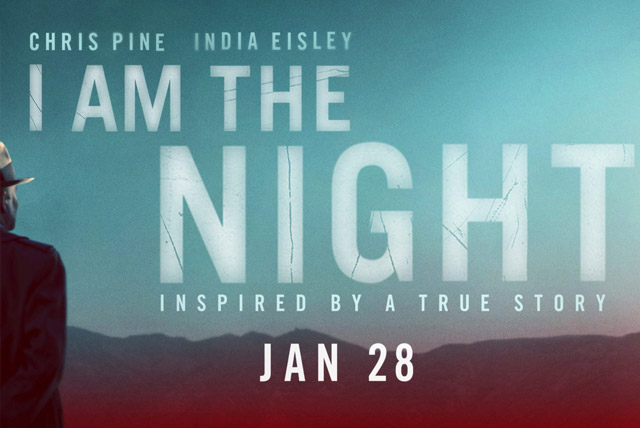
TNT is taking a shot at telling the Black Dahlia story when it releases the series I Am The Night on January 28th. The series will focus on the facts of the Black Dahlia case and will be told through the eyes of Dr. Hodel’s granddaughter, Fauna Hodel. Inspiration from the show comes from Fauna’s book she wrote about the murders, One Day She’ll Darken.

Remaining as one of the most famous unsolved homicide cases in the United States, the Black Dahlia murder was a brutal and unforgiving crime. Recent theories about the case have spawned a new limited-run series that will focus on facts from the case.

TNT’s I Am the Night – What We Know

Focusing on the Facts


The series will focus very loosely on the actual Black Dahlia case itself, and more on one of the top suspects who was never thoroughly investigated enough, Dr. George Hodel. This will be told through the eyes of the main character, his granddaughter, Fauna Hodel.

Based on the Book

I Am The Night

Inspiration from the show comes directly from the real-life Fauna Hodel and the book she wrote about her grandfather and the case called, One Day She’ll Darken, that was a hit with publishers in 2008. Quite possibly the closest source material to one of the most famous unsolved crimes ever, it looks back and covers her family’s darkest secrets.

Captain Kirk is on the case!

I Am The Night

Creatively, both on camera and behind the scenes is the popular Star Trek star, Chris Pine. Serving as a producer on this, he is joined by Patty Jenkins, director of Wonder Woman and the upcoming Wonder Woman 1984 fame. Their recent success and popularity have this series being talked about as a top contender for critical acclaim.

Companion Podcast

I Am The Night

TNT will launch an I Am The Night companion podcast titled Root of Evil: The True Story of the Hodel Family and the Black Dahlia on February 13th. The podcast will focus on the true events that inspired the show and will include interviews with the real people that were affected by the Black Dahlia murder.

Sordid History

I Am The Night

The limited six-episode series run will feature the complete sordid backstory for Fauna Hodel and why during a time of racial tension she was given up for adoption from a wealthy Southern California family. Was it impulse or nervous guilt as her legacy related to the Black Dahlia murder?

Season 2?

I Am The Night

Television network TNT will broadcast the show and add it to their newest lineup as a Suspense Collection series and if popular enough, a second season is a high possibility. Previous entries to the Suspense Collection series also include The Alienist which documented a child’s death in turn of the century New York City when the police commission was headed by none other than future President Theodore Roosevelt.