Exorcist

Man has always possessed an unslaked thirst for knowledge from the other side.  Historical texts tell of man wanting to contact the afterlife as far back as the Biblical days and the various warnings against it in Levitical texts from 538 B.C.  Curiosity cannot be helped as humanity wants to know what happens when we die.  Where do we go?  Who do we meet?  Boiled down, this curiosity evolves from a need for ultimate knowledge.  Over time there have been many ways and methods used to make contact and get these answers.  Divination rods, runes, tea leaves, seances, scrying, automatic writing, and even sigil spell-casting has been used to try and elicit answers from spirits.  All reasonable, yet they contain the fatal flaw of personal interpretation to try and decipher what spirits are trying to say, but is there another way?   Enter the Ouija board.

History of the Ouija Board

The Ouija board was first documented as being found in human history way back in China 1100 A.D.   It was a newly discovered way to conquer necromancy within the Jin Dynasty by forming drawn-out Chinese letters on matted bast fiber paper scraps.  Then an instrument called a planchette was uses in conjunction with the letterboard.  The planchette was a crudely shaped wood disk with the center removed leaving a quarter-sized hole that reveals just what letter the planchette happens to be situated over.  Subsequent boards were used for the next four hundred years until they were outlawed by the Qing Dynasty as being contrary to the moral good.  By the mid-1600s, the world was in love with Eastern Asia and many merchant ships with eager traders came in and out of the Orient and by proxy, the ouija board was further spread around the world to include stopovers in India, Africa, and most of Eastern Europe.

Elijah Bond, William Fuld, and The Ouija Board

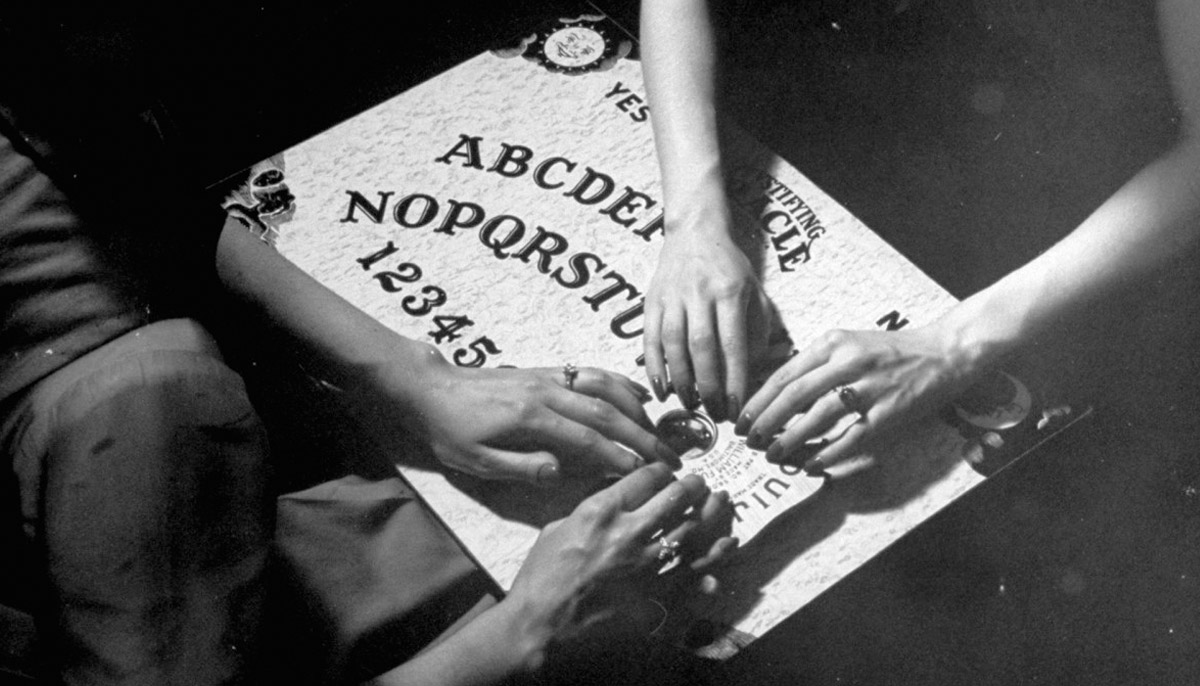
In 1890 an American inventor and businessman named Elijah Bond came across a rudimentary form of the ouija board.  Seizing the momentum on the popularity of post-Civil war seances that were occurring across the country (even former First Lady Mary Todd Lincoln was a rabid user of), Bond filed a formal patent on the board.  He slightly redesigned the planchette so as to have a see-through glass piece with a triangular gripping ridge to employ this as the must-have parlor game at the time.  He also formally pressed and printed out the board to include the full American English alphabet complete with number board as well as smaller whole words to include “yes”, “no”, and “goodbye”.

Ouija Tombstone

William Fuld’s Tombstone

Bond eventually sold his patent to an employee named William Fuld who set to formally market and name the board as the Ouija Board.  There has ample speculation on the name ouija itself.  Some historians believe it to be derived from an Egyptian phrasing that means “good luck”.  Others believe it to be a combination of the French word for yes (“oui”) and the German word for yes (“ja”).  Fuld took the board to new heights as Bond eventually passed away in 1921, yet he is still formally recognized as the father of the Ouija Board so much so that even his grave is modeled after the board.

The Ouija Board Goes Mainstream

The Ouija Board was subsequently marketed as a talking board; a fun-time parlor game for attendees to try and contact the other side with any burning questions they had.  Sensationalism grew from the board’s use and subsequent answers to the point science attempted to step in.  Prior to the board going mainstream, British scientists and founding father of electromagnetism Michael Faraday, attempted to debunk the board under controlled tests.  Faraday believed the responses from the board were not from spirits, yet an ideomotor response.  He theorized that participants in the board were subconsciously moving the planchette to answer questions with answers they wanted.  Faraday’s theory could have some credibility with one or two users as Ouija Board enthusiasts claim, but not party gatherings with seven or eight different people touching the planchette.  For Faraday, the rules of conjuring and talking to a spirit were too informal despite having some rules accompany the game; primarily that the board must be opened and then subsequently closed.

Parker Brothers Ouija Board

Parker Brothers Ouija Board

Eventually, the board was sold to Parker Brothers in 1967 who took advantage of the 20th Century’s fascination with the afterlife.  The gaming company redesigned the board to give it a sleek, yet dark look with an expertly crafted planchette and hailing production of the board straight from Salem, Massachusetts.  Marketed as family-friendly, the gaming company and board did run afoul of protests.  Christianity, and Catholicism in particular condemned the manufacture and use of the board as not a family-friendly game, but instead an ungodly way to make communion with powerful and dangerous demons.  In 1973 the box office horror smash film The Exorcist hit theaters depicting a young girl wickedly possessed by a profaning demon after having played with a seemingly harmless Ouija Board in her basement.

Famed paranormal talk radio show host Art Bell had a deep fascination with tales from the afterlife to a point in which he himself privately used a board.  His experience with the board yielded something so terrifying and revelatory to him that he refused to ever reveal what happened to him, which became a lifelong oath that he took to his very grave in 2019.

Today, the manufacture of the Ouija Board is still very much alive across all spectrums of capitalistic design.  Shirts, hats, coffee mugs, keychains, and even doormats styled after the Ouija Board are directly available for purchase.   Through social media, there are Ouija Board seances, consultations, and even how-to’s across a wide array of channels.  For every video documenting its experimental use, there is another debating against it.  There is no question that using a Ouija Board opens up a powerful doorway to the spirit world, but in using one must always remember that you never know exactly who…or what….you may be talking to.

Was the Exorcism of Emily Rose Real?

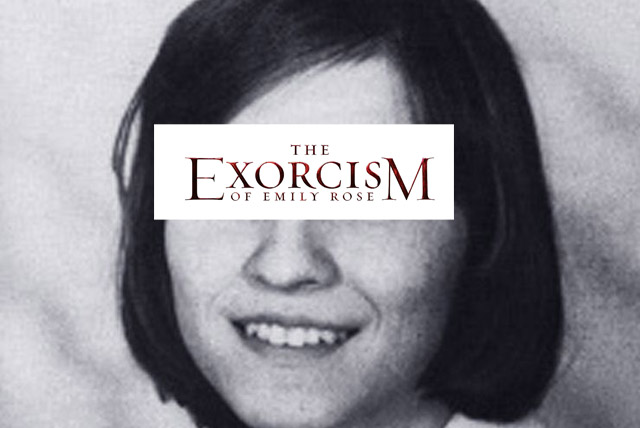
Sometimes, we comfort ourselves when watching something frightening or disturbing by telling ourselves, “It’s not real. It’s made up.” Unfortunately, this just won’t work when it comes to the true story behind the Scott Derrickson film The Exorcism of Emily Rose. The Exorcism of Emily Rose is based on the very true and very tragic events that happened to Annaliese Michel. Her life story would lead to one of the most unsettling and widely accepted accounts of possession to date.

The Exorcism of Emily Rose

Who Was The Real Emily Rose?

The Exorcism of Emily Rose was based on the true story of Anneliese Michel. Anneliese Michel was born in 1952 in Klingenberg, Bavaria, West Germany to a deeply Catholic family. Anneliese had a normal and happy childhood until 1968 when she experienced her first blackout episode. After being rushed to the hospital, she was diagnosed with epilepsy and admitted to a psychiatric hospital. Shortly after having her third seizure while staying there, she was given an anti-convulsive medication. During this time, she started describing faces of the devil that taunted her throughout the day. As a result, her doctor prescribed her a medication meant for various psychoses including schizophrenia.

Anneliese Michel - The Real Life Emily Rose

By 1973, she was given an anti-seizure medication in hopes it would ease her attacks, but to no avail. She suffered from manic depression and became frustrated in the failure of the medication she took for so long. Strangely, she also became intolerant of religious objects such as the crucifix and started denouncing religious figures. To her mother’s horror, she found Annaliese staring hatefully at a statue of the Virgin Mary one day. Annaliese said she could not look directly at a picture of Christ because he “sparkled so immensely.” She also started describing voices in her head telling her that she was “damned” and would “rot in hell.” In 1975, Anneliese became very aggressive and started physically deteriorating. She would hurt herself and family members, eat spiders and flies, and drink her own urine off the floor.

The Exorcism of Emily Rose AKA Annaliese Michel

After displaying such horrifying behavior, the Michel family went in search of a priest, convinced their daughter was possessed by a demon. Father Ernst Alt answered the families prayers and said he would try and help Anneliese. The Michel parents, with the support of Father Alt, requested an exorcism. That September of 1975, a priest named Arnold Renz was given permission from the Vatican to start performing exorcisms on Annaliese right away.

The first exorcism took place on September 24, 1975. Over the course of ten months, 67 total exorcisms would be performed. Plus, 43 voice recordings were collected, as well as disturbing videos of the convulsing Annaliese. When questioned by Father Renz, Annaliese identified her demons as Lucifer, Cain, Judas Iscariot, Hitler, and Nero. Towards the end of her life, Annaliese started to physically deteriorate by starving and biting herself. However, she refused medical care or any doctor visits. A day after her last exorcism, Anneliese died of malnutrition and dehydration. She weighed only 68 pounds and was unable to move without assistance due to both of her knees being broken from constant genuflections.

Anneliese Michel - The Real Life Emily Rose

After an investigation of her death, the Michels and priests Renz and Alt were charged with negligent homicide since it was determined that Anneliese’s death could have been easily prevented. The Michel’s defense was that their daughter was possessed and they were doing what they needed to save her. The audio recordings of the exorcisms were played as evidence but were not taken seriously by the court.

They also took the stance that it was in Anneliese’s legal right to refuse medical treatment and that something like force feeding her would have violated that right. However, doctor Richard Roth, who came at the request of Father Alt during one of the many exorcisms, told the court that it was a psychological effect born of both her strict religious upbringing and her epilepsy. According to Father Alt, this does not line up with the events of doctor Roth’s visit where he allegedly said, “there is no injection against the devil, Anneliese.” The Michel’s lawyer also brought up the point that the exorcism was completely legal and that the German constitution protected their right to an unrestricted exercise of their religious beliefs.

The Michels, Father Alt, and Father Renz were all found guilty after the case was ruled a misidentification of mental illness rather than possession. The priests were fined while the Michels were found guilty. The Michels were not punished since the prosecutor believed that they had “suffered enough.” Two years after the case closed, the Catholic church publicly acknowledged that in the case of Anneliese Michel, it was a mental illness that she suffered from rather than demons.

More Exorcist & Exorcisms

Visit the Real Exorcist House, where it all started.
The infamous Exorcist Stairs from the movie.

A little before and after New Year’s with our favorite little party animal.

After New Years Exorcist Party Animal

Someone may have overdone it last night.

Happy New Year!! Looking forward to more scares in 2016!